AI. Leveraged to
what you commit to.
Organisations adopting AI are acquiring new power — to scale decisions, automate processes, and move faster than traditional oversight can follow. Sovaign connects your obligations to the evidence, reasoning, and system behaviour that proves you live up to them.
The problem
A gap still exists
Most organisations put effort into two systems: compliance — frameworks, audits, policies — and operations — data, AI, decisions. Compliance describes what we want to happen. Operations is what does happen. As things are ever changing, keeping the gap between these small does not happen automatically.
AI makes this gap harder to hide, but also easier to close. Automated scrutiny and new standards — ISO 42001 for AI management systems, the EU AI Act — mean that producing the right documentation is no longer sufficient. The good news: with AI, that gap can be closed at both ends: policy can influence process more easily, and compliance doesn't need to be artificially structured, but can be discovered and flow from good operational practices.
Documented compliance: obligations connected to proof
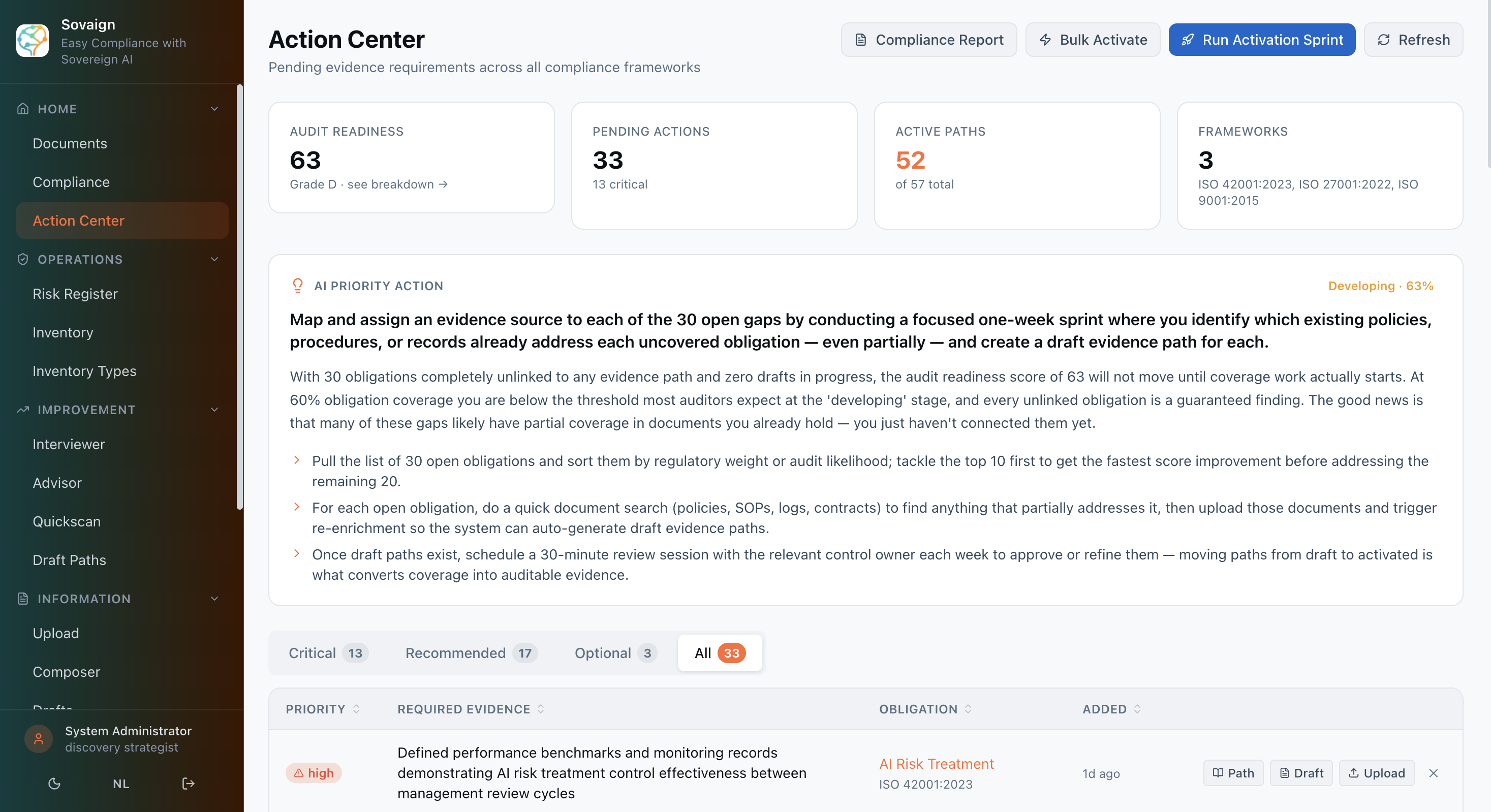
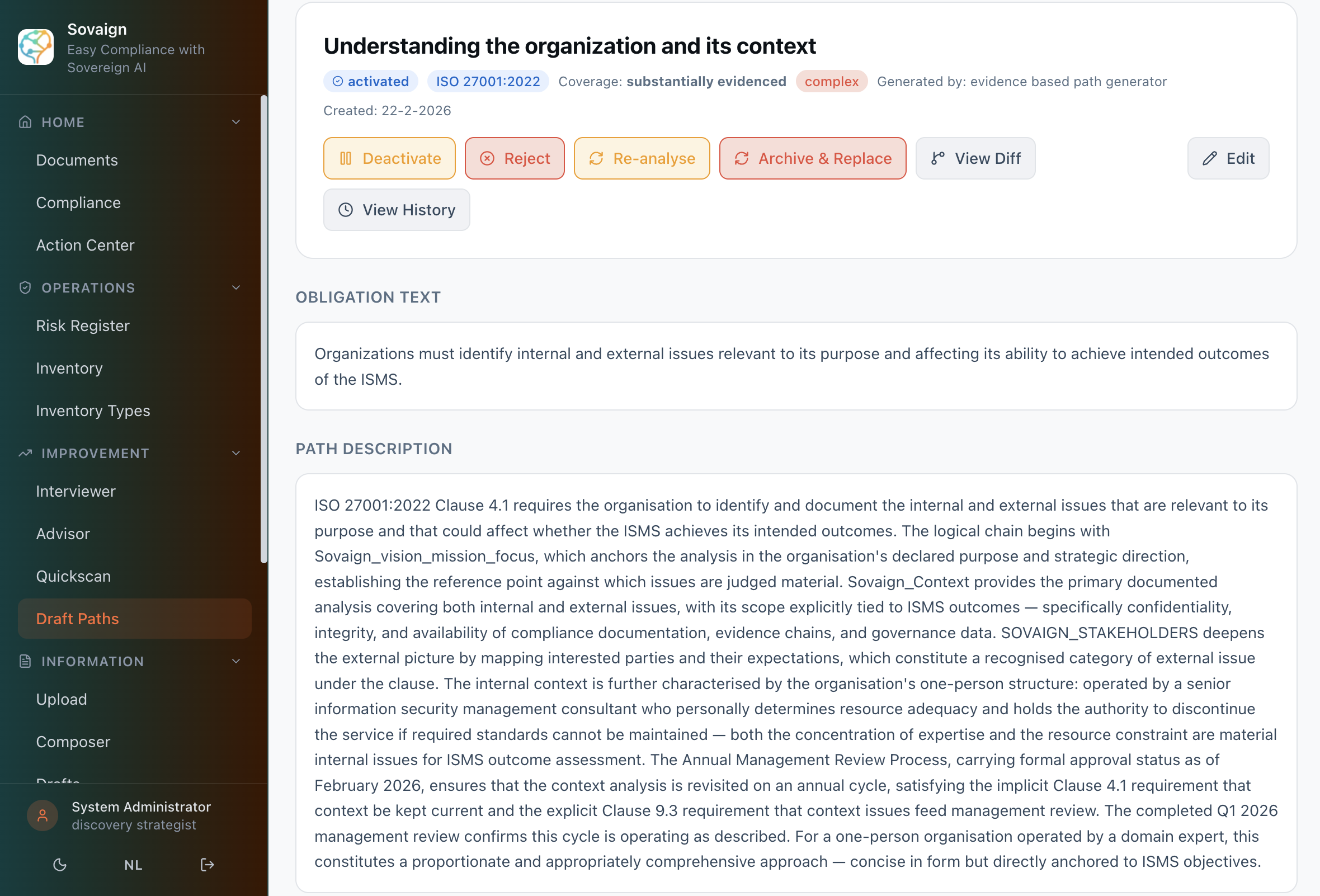
Your policies, procedures, frameworks and evidence documents contain most of your compliance story — they are just not connected. Sovaign ingests your documents, maps them to obligations across your active frameworks, and uses AI to generate evidence paths with traceable reasoning you can inspect, challenge and approve. Gaps become visible before auditors find them.
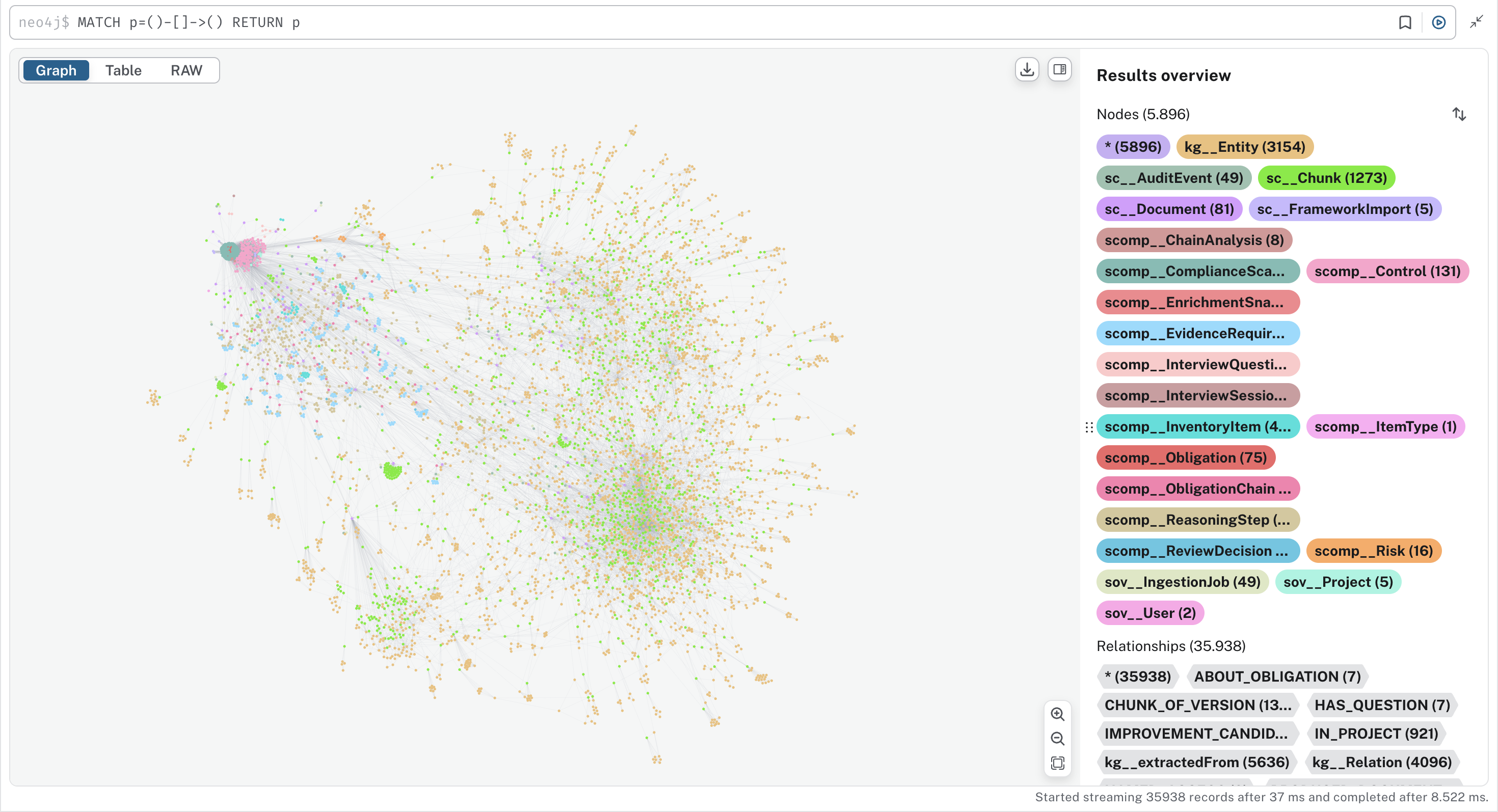
Numbers from a working instance. Your graph grows as you ingest your own documents.
Note: this is not yet another human-centered SaaS compliance tool with templates. This is:
- Human + AI agents working together on your compliance posture
- Flexible — AI gateway to any local or frontier LLM, MCP built in, vector embedding and APIs for agentic work
- Your own sovereign memory storage — no lock-in to someone else's AI memory silo
Sovaign leverages AI to discover and optimise how you work and how that maps to your obligations — including compliance frameworks. It is designed to avoid the dependency trap of proprietary AI memory and tooling.
Behavioural intelligence: watch what your systems actually do
Document analysis tells you what your organisation says it does. The next layer watches what it actually does.
Sovaign's AI bus connects to your data flows, decision pipelines and system events — monitoring them against your stated obligations in real time. When your AI system makes a decision, your compliance layer can determine whether that decision was within scope. When data moves, you know whether your controls applied.
This is where compliance becomes a genuine accelerant. When your accountability infrastructure is live and continuous, your risk surface is known rather than guessed — and you can move faster because of it.
Policy that runs, not just sits
The previous two phases close the gap from the compliance side: capturing what is happening, surfacing what is not aligned. Phase 3 closes it from the other direction.
Current AI makes it practical to give an agent a policy — a real one, with context, conditions, and priorities — and have it act on that policy in operations. Not summarise it. Not flag deviations. Act.
We built SATO, our multi-agent orchestration framework, on this premise. Agents are instructed with the rules that matter to an organisation: what to do when, according to which standard, with which constraints. They then operate within those bounds — routinely, consistently, and with a record of every decision they made and why.
This is not autonomous AI replacing judgement. The value is narrower and more honest: things that should happen the same way every time, reliably do. And when something falls outside the policy, it escalates rather than guesses.
The compliance-operations gap, closed from both ends.
The vision
Accountability as infrastructure
The old compliance model was built for a slower world. Periodic audits, curated disclosures, certification rituals. In that world, trust could be approximated through documents and ceremonies. That is no longer enough.
AI gives organisations new power to scale decisions and move faster than traditional oversight can follow. But it also gives regulators, customers, partners and citizens new power to investigate, compare and challenge. The organisations that will be trusted are those that can show how they behave — not just claim it.
This is not about compliance as cost centre. It is about accountability as competitive infrastructure. Organisations that build this now can answer audits in hours rather than months, deploy AI with a known risk surface, and earn trust that is harder to fake and harder to lose.