The problem with pre-built compliance structures
Traditional compliance tools have a fixed shape. There is a list of controls. Each control has a box. You fill in the box and attach a document. Done.
The problem is that your organisation does not have that shape. Your evidence is spread across policy documents, meeting notes, risk assessments, supplier contracts, interview records, and procedure manuals — written at different times, by different people, for different purposes. The connection between "what ISO 27001 requires you to do" and "what you actually do" is real, but it is not obvious, and it is certainly not pre-labelled.
So you spend audit season doing the translation manually: reading documents, deciding what counts as evidence, mapping it to the right control, writing a justification. Every year. From scratch. Or close enough to scratch that it feels that way.
What hub-and-spoke changes
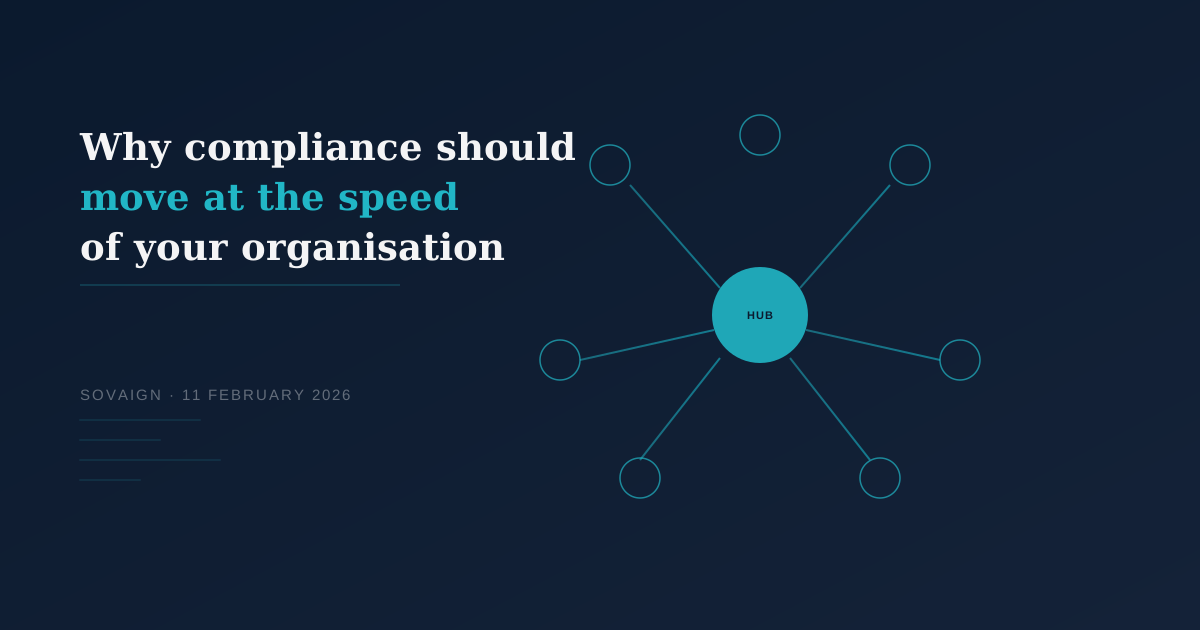
In February 2026, we restructured how Sovaign reasons about compliance around a hub-and-spoke model. It is the architectural decision that made the most difference to how the system actually works — and it is easier to explain than it might sound.
The hub is an obligation: a specific, concrete requirement from a framework. "Organisations must identify internal and external issues relevant to their purpose." That is ISO 27001, clause 4.1. It says something precise. It does not tell you what shape your evidence should take.
The spokes are reasoning chains: paths that AI constructs by reading your documents and working out what actually satisfies that obligation in your specific organisation. Not by searching for keywords. By reasoning about meaning — the same way a good compliance consultant reads a policy and thinks "yes, this covers it, here is why."
The result is a path that says: this obligation is addressed by this control, which is supported by these three documents, connected in this way, with this level of confidence. The AI writes the reasoning out in full. You can read it, challenge it, improve it, and — when you are satisfied — approve it. At that point it becomes authoritative. Until then, it is a draft.
Creative and analytical, but anchored
This is where the model gets interesting. AI is genuinely good at making connections that humans miss — reading across a large body of documents, spotting that your data protection policy actually speaks to a control you had not linked it to, or that your management review minutes contain evidence relevant to three different obligations at once.
That creative, associative capability is exactly what makes manual compliance mapping so slow. A person can do it, but not across eighty documents and seventy-five obligations simultaneously. AI can.
But AI can also be wrong. It can sound confident about a connection that does not hold. That is the hallucination problem — and it is a real one, especially in a context where accuracy matters as much as it does in compliance.
The hub-and-spoke model handles this structurally. Every spoke — every piece of AI reasoning — is traceable back to a specific source. The AI does not just assert coverage; it cites the document, the passage, and the logical chain. And it does not become authoritative until a human has reviewed and approved it. The creative power of AI and the reliability of human judgement are not in competition; they operate in sequence.
Flexible, but replicable
The other thing the hub-and-spoke model solves is the tension between flexibility and consistency.
No two organisations have exactly the same compliance posture. A single-person consultancy has a very different information security context than a two-hundred-person financial services firm. A fixed template cannot serve both well. It either over-specifies (forcing the smaller organisation to document things that don't apply) or under-specifies (giving the larger one false comfort that generic answers are sufficient).
Hub-and-spoke does not impose a structure on your evidence. It discovers what structure your evidence already has. The obligations come from the framework — that part is fixed. How you satisfy them is discovered from your documents — that part is yours.
At the same time, the results are not ephemeral. Once a reasoning chain is approved, it is stored in the knowledge graph permanently. The next person who reviews that obligation starts from the existing chain — they do not start from scratch. The next AI session reads the same structured knowledge. When you update a policy, the system knows which obligations that policy supports and can flag which chains may need re-evaluation.
The compliance picture moves when your organisation moves. That is what it means for compliance to run at organisational speed rather than audit speed.
What this looks like in practice
In a working Sovaign instance right now, a compliance team can open an obligation, read the AI-generated reasoning chain that connects it to their evidence, see which documents are cited, approve or challenge the reasoning, and have that decision become part of a persistent, queryable record — in minutes rather than hours.
When an auditor asks "how do you satisfy clause 4.1?", the answer is not a folder of documents. It is a structured path: here is the control, here is the evidence, here is the reasoning that connects them, and here is the date a qualified person reviewed and confirmed it.
That is what we mean when we say compliance can become infrastructure rather than ceremony. Not because the work disappears — the reasoning still needs to be right — but because the work accumulates rather than resets, and the knowledge stays where you can use it.